♱✠☧ Methods & Techniques ☧✠♱
[Pardon the disorganization of this page. It is presently being edited.]
--------------------
St. Teresa of Ávila’s paramount teaching on prayer:“Mirar a quién hablamos” /“Poner atención con quién hablamos” – “Look to whom we are speaking.” / “Place attention with [Pay attention to] whom we are speaking.”
Awareness of God’s omnipresence: He is immanent before you, all around you, pervading through all matter, and dwelling at the core of your essence (indwelling):
Sénsus praeséntiae Déi – Sense of the presence of God
• Ultimate, lofty goal: Sénsus praeséntiae Déicontínuus – Continuous sense of the presence of God
• Note: Br. Lawrence attained the continuous sense of the presence of God by ruminating for ten years on his past sins, while living his
vocation as a Religious.Simplícitas orátio / Orátio símplex / Orátio affectíva símplex / Recolléctio acquísita / Recolléctio actíva – Prayer of Simplicity / Simple Prayer / Simplified Affective Prayer / Acquired Recollection / Active Recollection
Oblátio córdis contínua / Oblátio súi assídua / Oblátioassídua – Continuous Offering of the Heart / Assiduous Offering of the Self / Assiduous Offering
(“of the Heart or Self” is implied in ascetical and mystical theology)• Ultimate, lofty goal, and ultimate Catholic position: Aconstant, ardent desire to suffer for Jesus Christ and to glorify God.
• Pauline Emphasis: “Síne intermíssione oráte”(1 Thes. V, 17) – “Without ceasing, pray.”
• Augustinian Emphasis: “Ípsum énim desidérium túumorátio túa est˙ etsi contínuum desidérium• contínuaorátio.” – “For your very desire is your prayer; and if the desireis continuous, the prayer is continuous.” / “Ípsum desidérium túum, orátiotúa est” / “Desidérium est orátio túa” / “Desidérium est orátio”
• The “loom” or “warp and weft” of continuousprayer: At transitions, from one task to the next or from one location to
another, etc., devoutly dedicate your upcoming task to God by saying a shortprayer (such as, “For You, God”) or devoutly make the Sign of the Cross with
the intention of dedication.• Repeated Aspirations (the phraseology of the Latin onesare frequently attested in Church liturgy or authoritative treatises, and are
idiomatic to and morphosyntactically correct for Ecclesiastical Latin):“Hóc Tíbi offéro, Déus” / “Hóc Tíbi offéro, Dómine” / “HócTíbi offéro, Sáncte Spíritus” – “I offer this to You…”
“Tíbi offéro, Déus” / “Tíbi offéro, Dómine” / “Tíbi offéro,Sáncte Spíritus” – “I offer [this] to You…”
“Tíbi, Déus” / “Tíbi, Dómine” / “Tíbi, Sáncte Spíritus” –“For You…”
“Ád Té, Déus” / “Ád Té, Dómine” / “Ád Té, Sancti Spíritus” –“Unto Thee…”
“For You, God. For You, God. Not for me, God. Not for me,God. Every thought, word and deed for You, God. My every motion for You, God.
My every breath for You, God. My every heartbeat for You, God. My every moment
to You, God.”“Sacred Heart of Jesus, in love for Thee, I offer thismoment to Thee.”
“The Sorrowful and Immaculate Heart of Mary, give me lovefor the Sacred Heart of Jesus.”
Upon returning from distractions:
“Ád Té convértor, Déus” / “Ád Té convértor, Dómine” / “Ád Téconvértor, Sáncte Spíritus.” – “To Thee, I turn…” / “ToThee, I return…”
Assent and Attendance to God for a Minimal Degree of thePrayerful Life (for beginners, or those whose habit of prayer has
deteriorated):“I assent to Thee, God. Now, please, do the rest.”
Instructions for Deliverance fromSuffering (Supplication for Suffering to be Removed, Abandonment to Divine
Help; Not Redemptive Suffering to be Endured)Pray to God or St. Mary to take the suffering, temptation,distraction, etc. away from you.
Trust it will be taken away from you.
Pray for the grace to overcome it.
Initiate Prayer of Simplicity / Simple Prayer / Prayer ofSimple Gaze
Optional: Conduct an avocation or a task of labor(chore, work, etc.).
Optional: Frequently practice delivering not only evilthings and sufferings but good things and pleasant things as well, sucha feelings of joy, experiences of pleasure, etc., as well as every otherinterior phenomenon or experience of consciousness in order for you toprogress in the rejection of distractions for the benefit of maintaining focus
and to cultivate the habit of abandonment and the disposition of dependence.Practice a disposition opposite to the pride of life: the humilityof death; death of the will, total dependence on God, submission to His will (Commandments,
Church Precepts, the natural law) and to ProvidencePractice a disposition opposite to spiritual pride: spiritualhumility / poverty of spirit; acknowledgement of spiritual bankruptcy, utter dependence
upon God for any goodness (and the acknowledgment of any natural goodness
having its source in Him)Cultivate humility and spiritualhumility: “I am nothing without Your consent for me to exist; my existence is
contingent upon Thy will. I am sinful without Your grace and without devotion
to Thee.” Cultivate humility,such as with prayerful recitation of the words “humílitas” (“humility”) and “húmus” (“dirt”; pronounced “hūmus,” “OO-mus”) – the word fromwhich St. Thomas Aquinas speculated “humílitas” derives. Especiallycultivate spiritual humility(the deep belief that, by his own powers, man cannot earn God’s favor or
blessings at all, nor achieve any supernaturally spiritual progress, nor
achieve spiritual perfection, nor achieve a heavenly afterlife; the opposite of
the most insidious vice, spiritual pride). Pray for an increased sense, awareness, and acceptance of your spiritualpoverty (“poor in spirit” – from Matthew V, 3), which is a universal andinnate trait of human beings (i.e., inherent to fallen human nature). Abhor all
interior semblances of spiritual pride. Cultivateand practice generosity, dedication, and devotion to God. To love God more,
learn about Him, meditate and contemplate upon the Holy Trinity and His laws,
increasingly think about Him, increasingly dedicate every thought, word and deed
to Him, every breath and heartbeat to Him, every action and every moment to
Him; and increasingly sacrifice other objects of affection (i.e., other loves
of your life) for the sake of your love for God – sacrificed in union with
Christ’s passion and in union with the Holy Sacrifice of the Mass (tothe extent that valid ones still occur).Cultivate penitence andcontrition: “I’m sorry, God.” Prayerfully list your sins, offenses, objects of
guilt; make a spiritual Confession. Meditate upon any and all past sins — the
seemingly essential, decade-long element to Br. Lawrence’s gift of the
continuous sense of the presence of God.
Cultivate primary charity, love for Godabove all Else: “I love You, God.” Prayerfully list the reasons you love God
and the reasons why you should love God.---
Lectio, Meditatio, Oratio, ContemplatioBecause contemplatio is infused, allow me to propose ascetical alternatives for it that can be practiced by human effort – what the commentators, taxonomists, and systematizers of mystical experiences called “acquired contemplation,” (a confused and self-contradictory term this present instructor prefers not to use): Pure Prayer, Otium Sanctum, Prayer of Recollection, etc.
Evagrius Ponticus (condemned heretic by the Roman Catholic Church whose legitimate ascetical teachings were later systematized, translated, and adapted for the Western Church by recognized Roman Catholic saint John Cassian) developed a method of prayer he called “Pure Prayer.” St John Cassian called it the “Prayer of Fire” or the called “Fiery Prayer.”Pure Prayer is a practice of clearing the mind of all forms, concepts, images, words, feelings, etc. in order to rest in communion with God. It is nonconceptual, formless, imageless, and wordless because God is immaterial, He is pure spirit. It is prayer to the exclusion of all thoughts (logismoi); the renunciation of all thoughts and concepts, or forms, from the mind in order for to rest in communion with God.
---
Monologic Prayers, Monologistos (Koine Greek) – Vocal or subvocal prayers consisting of a single word, phrase, or verse repeated continuously to the exclusion of other thoughts (logismoi) while doing nothing else (sitting) or while conducting menial or repetitive work that does not require much thought, such as basket-weaving (the work many of the Desert Fathers did). Originally developed by Evagrius Pontincus (condemned heretic by the Roman Catholic Church whose legitimate ascetical teachings were later systematized, translated, and adapted for the Western Church by recognized Roman Catholic saint John Cassian) and distinct from Arrow Prayers, Darts, Aspirations, or Jaculatory Prayers/Ejaculations in that monologic prayers are repeated continuously while Arrow Prayers are only said once and as needed. This is the literal interpretation of “Pray without ceasing” (1 Thessalonians V, 17) — as opposed to the more normative interpretation explained by St. Augustine as, “For your very desire is your prayer; and if the desire is continuous, the prayer is continuous.” [“Ípsum énim desidérium túum orátio túa est˙ etsi contínuum desidérium• contínua orátio.”] — that the hesychasts practiced using the Jesus Prayer (“Lord Jesus Christ, Son of God, have mercy onme, a sinner.”). Note that hesychism, or more precisely, the expectations therefrom, were condemned by the Roman Church: quietism, uncreated light phenomenon, essence and energies distinction, pursuance of special states of consciousness. Beware of quietism, viz., the annihilation of the will, namely as regards acts of charity or the receptivity of grace — as opposed to quietude, viz., the renunciation and silencing of thoughts, temptations, and all other distractions.Examples of vocal prayers, words, phrases, or verses utilized for monlogic prayer (vocalized repeatedly and continously throughout the day; through rest, avocations, and work alike):
Deus In Adjutorium (Psalm LXIX, 2) — utilized by Evagrius Pontincus himself
“O God, come to my assistance; O Lord, make haste to help me.”“Deus, in adjutorium meum intende; Domine, ad adjuvandum me festina.”
The Jesus Prayer — utilized by the hesychastsThe Angelic Salution (the Hail Mary)
The Name “God”
The dedication or commendation, “For You, God. For You, God. Every thought, word, and deed for You, God. Every breath for You, God. Every heartbeat for You, God.”
---
---
Sénsus praeséntiae Déi (contínuus) (Br. Lawrence) — a “perpetual habitude of unremitting communion suffusing all mundane avocations,” (per DeepSeek) in contrast to oratio simplicitatis, which is a “circumscribed methodological exercise of formal orison” (per DeepSeek).
The Sacrament of the Present Moment (Fr. Jean-Pierre de Caussade)
Abandonment to Divine Providence (Fr. Jean-Pierre de Caussade)
Lectio Spiritualis on Ascetical and Mystical Theology, namely the Taxonomy or Systematization of Methods of Prayer and the Degrees of Prayer Phenomena from the Desert Fathers (only those whose methods were not condemned by the Church) to the Roman Catholic saints, mystics, writers and systematizers up to the mid-20th C. (e.g., reading Tanquerey’s The Spiritual Life)
Lectio Spiritualis of Hagiographies (Lives of the Saints)
Learn the Divine Office (memorize chants; learn tones)
Evangelization/Apostolate (leafletting, canvassing, website)
Renounce all Idle Thoughts — replace them with work dedicated to God or with continuous vocal, mental subvocal prayer, e.g., the Angelic Salutation / Ave Maria, or repeating the name “God,” or the multiple names of God, or making Commendations (e.g., “For You, God. For You, God. Every thought, word, and deed for You, God. Every breath for You, God. Every heartbeat for You, God.”), or praying Darts / Ejaculations or Aspirations, or initiating mental prayer (e.g., Oratio Simplicitatis) throughout avocations or rest.
Joined Hands Posture in Most Spare Time or While Walking Without Carrying Anything (or if One Hand is Occupied, Keeping the Other on One’s Chest) — as the traditional rubric reads:
"Junctis manibus ante pectus, extensis et junctis pariter digitis, et pollice dextro super sinistrum posito in modum crucis.”
("With hands joined before the breast, the fingers extended and joined together, and the right thumb placed over the left in the form of a cross.")
Heeding Every Inward Summons to Prayer — at least by an interior act of prayer, or freely enacting outward signs (making the Sign of the Cross, vocal prayer, kneeling) even in public, despite Morrow's proscription in his catechism My Catholic Faith: A Manual of Religion. Shame not such fervor, especially in neophytes, for they betoken compunction and docility (or, obedience) to divine breath (or, Holy Inspiration Himself), and any scruples therein will be purged by maturation in the life of prayer. To refuse such a call is to hazard its future suppression by habit or by God’s withholding of grace. (DeepSeek’s refined version, with edits, of the original: Assenting to Every Instance of an Interior Call to Prayer by at Least Making an Interior Acknowledgement but also even Freely Conducting Exterior Acts of Prayer — disavowing the teaching in some traditional catechism’s (such as Morrow’s My Catholic Faith: A Manual of Religion) that one should not spontaneously make acts of prayer in public. If one feels the need to make the sign of the cross, begin a vocal prayer while out and about, or even fall on his knees in public and pray very affectively, he ought not be discouraged or shamed for it, for such things, especially in novices, are acts of compunction and obedience to Holy Inspiration and any possible scrupulosity therein will be corrected by his refinement in his ongoing life of prayer. To deny any interior call to prayer is liable to result in a withholding or privation of future interior calls to prayer, by one’s own habit or by God’s disapproval of the monastic’s assent to pray when called to.)
Maintain a Holy, Devotional (to Continue to Serve or Give of Oneself to One’s Own Discomfort or Suffering), Confessional (Maintains to Profess the Faith to One’s Own Discomfort of Suffering), Humble, Penitential, Prayerful Mindset / State of Mind — Dedicate or commend every thought, word, and deed (i.e., interior or exterior act or action) to God.
The Work and the Mark of Progress in Devotion and Attention is the Discarding of Distractions, thus, Maintain a Recollected Mind by Renouncing or Discarding All Distractions by Retaining the Knowledge that Renouncing or Discarding Distractions is the Work of Excelling in Mental Focus/Concentration or Attention/Awareness/Recollection/Vigilance and is the Mark or Sign of Excelling in Mental Focus/Concentration or Attention/Awareness/Recollection/Vigilance — In all things, renounce and disregard mental distractions. Increasingly notice the increasingly subtle (i.e., diminishing, getting smaller) interior, near occasions of distraction, i.e., the subliminal/liminal, faint, or wisps of, idle thoughts, emotions, or temptations, and discard them. Discard increasingly subtle distractions: whether in rest, recreation, desultory rumination (unfocused, unstructured, digressive thinking), discursive cogitation (logical, methodical, systematic thinking), menial tasks, good works, prayer, etc., renounce or discard all distractions, for such is the work and mark/sign of progress in mental focus/concentration or attention/awareness/recollection/vigilance.
Realizing and Maintaining the Comprehension that Most People are Bad Regardless How Benevolent, Amiable, Generous, Etc., and that Goodness is Determined by Conforming to the Ancient, Medieval / Age of Faith, Tridentine, Intransigent, Magisterium-Revering, (Sedevacantist) Catholic Standard of Sinlessness and the Condemnation of Sins in Others, from Those of Naturalism, Materialism, Religious Indifference, Modernism, Down to the Smallest Matters of Freedom, Gossip, Emotional Lability, Entertainments, Loquaciousness, Luxuries, Fastidiousness and Sumptuousness in Eating, Idleness, and All Else that Moderns Perceive as Normal, Good, or Superlative but Which are, in Truth, Bad — Making oneself a soldier of Christ and a defender of the Faith in all matters, great and small, public and private, exterior and interior. Nearly all that which you thought good will be revealed as bad. Nearly all those whom you thought good will be revealed as bad. True Catholicism has the highest standards of goodness/the good (that of Plato, et al.). That which is natural is good (refuting the modern misnomer called the “naturalistic fallacy”) — any disputation of that will find its error in the disordered or improper context therein (viz., that which, in right and proper order, is natural is good). The natural law is improved by the Faith. Human nature at its natural best is improved even further by the Faith.
Br. Lawrence’s presence of God and dedication of all actions to God as prayers.---
Abandonment to Divine Providence
Beware the Signs of Predestination
---
Br. Lawrence - Presence of God, Commending every action to God as a prayer
Sacrament of the present moment
Abandonment to divine providence
The Cloud of Unknowing (book), by (Anonymous)
---
---
Mental articulation of lexical expressions/words is called subvocalization, or, to distinguish it from extremely soft-spoken or whispered prayer, mental subvocalization.
---
---
Having pursued the topic that is the controversy of acquired contemplation, I now confidently posit that when St. Thomas Aquinas and St. Teresa of Ávila (and Guigo II if he ever did so) used the word contemplation (its translation) in a sense other than the purely infused gift (from God) of understanding or wisdom about a truth, they meant it in the sense of otium sanctum, rest in the awareness of God, single-pointed consideration (consideratio) with attention (attentio), that is, exclusive mental focus upon the object in mind, without discursive reflection, or ratiocination, or cogitation. Perhaps that is precisely what the proponents of acquired contemplation meant that when they distinguished it from mystical/infused/passive contemplation.
Repeat the name “God” in your mind throughout the day to the extent possible, or otherwise mentally pray “For You, God” to commend every thought, word, and deed of yours to Him.
Imagine St. Mary enthroned in heaven with her right hand extended holding a Rosary.
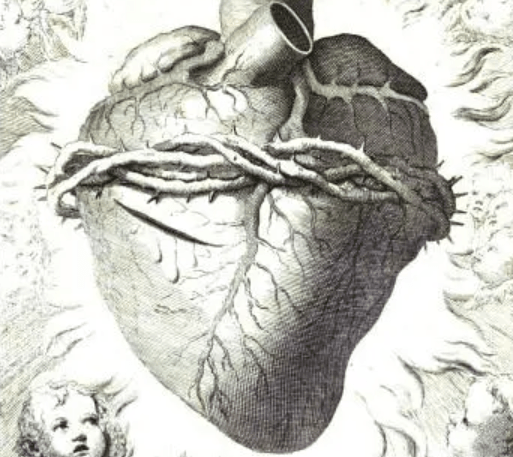
Imagine the Sacred Heart of Jesus with Its attributes: thorn-crowned, beating, pierced, and bleeding. Subvocalize those attributes.
Pray the entire, 15-decade Rosary every day
Pray the Stations of the Cross every day. (See: "Way of the Cross" by St. Alphonsus de Liguori)
Lectio divina of the Penitential Psalms every day.
---
ascetical praxis — bodily, cognitive, and disciplinary techniques the tradition developed for shaping disposition
Bodily/postural techniques
• Prostration counting (metaniai) — Desert Fathers (Abba Poemen, Sayings) prescribed fixed numbers of full prostrations tied not to a prayer text but as a standalone disposition-forming discipline; the physical act of repeated self-lowering was held to work on pride independent of any accompanying words.
• Custody of the eyes (custodia oculorum) as active technique, not passive avoidance — Cassian and later Rodriguez’s Practice of Christian and Religious Perfection treat deliberate, systematic control of gaze-direction as a disposition-trainer: where the eye habitually rests, the heart follows. Largely forgotten as a trained skill rather than a rule of modesty.
• Fixed bodily posture during manual labor — the Pachomian and later Benedictine principle that the body kept in disciplined position (not slouched, not idle) during work itself forms interior recollection; this is ora et labora taken as a psychophysical claim, not just a schedule.
Cognitive/attentional techniques
• The logismoi diagnostic method — Evagrius Ponticus’s eight-thought taxonomy (Praktikos) is not primarily a moral list but a technique: naming and tracking which thought-category is currently operative, on the theory that accurate diagnosis alone weakens the thought’s grip. This is close to a formal cognitive-behavioral method and is almost entirely unknown outside patristic specialists.
• “Watching the door of the heart” (nepsis, vigilance) — the technique of maintained low-grade self-observation at the threshold of consciousness, distinguished by Hesychius of Sinai and Philotheus of Sinai (both in the Evagrian-Cassianic line) from simple self-examination: it is continuous, not periodic.
• Delayed consent (mora) — Scholastic moral theology’s technique of consciously interposing a gap between the arising of a thought and any act of will toward it; this is procedural, not devotional, and shows up in confessors’ manuals as something actually taught, not merely described.
Structured self-examination techniques
• The particular examen — Ignatius’s Spiritual Exercises method of tracking a single named fault through the day with tally-marks or similar, reviewed twice daily; this is a behavioral-tracking technique centuries before the term existed, and it’s routinely reduced in popular retellings to “examine your conscience,” losing the actual mechanism (single-fault focus, quantified tracking, twice-daily review).
• Confessors’ “book of the heart” — some pre-1954 manuals for religious recommend a written, dated log of temptations and their circumstances (time, place, preceding state) specifically to identify patterns — an ascetical precursor to what a modern person would call a trigger log.
Disposition through altered ordinary activity
• Custody of speech via silence-hours — not total silence, but the Benedictine/Trappist technique of scheduled silence at specific hours regardless of felt need, on the theory that the discipline itself (not the content of what’s avoided) forms recollection.
• The “sacrament of the present moment” (de Caussade) — deliberately underused because de Caussade’s L’Abandon à la Providence Divine frames ordinary duty, performed with full attention, as itself the primary ascetical technique — no special prayer or posture, just totalized attention to the present duty as a substitute for seeking extraordinary spiritual experiences.
• Manual labor as antidote to acedia — Evagrius and Cassian’s specific prescription (not “keep busy” generally, but rope-weaving/basket-weaving as the Desert Fathers’ literal named remedy) for the noonday demon; the technique is body-occupation calibrated to be repetitive enough to leave the mind still available for prayer, unlike complex work.
Relational/social techniques
• Manifestation of thoughts to an elder — daily or frequent disclosure of interior movements to a spiritual father, prescribed by Cassian as more effective than private struggle because concealment itself was held to be what gave a thought power (Institutes IV, and Conferences II). This is structurally different from confession — it’s diagnostic disclosure, not sacramental, and largely vanished from Western practice after the early medieval period.
• Fraternal correction as reciprocal technique — Desert Fathers’ practice of accepting correction specifically from those one might consider inferior, as a deliberate disposition-trainer against spiritual pride, distinguished from mere obedience to superiors.
Memory/imaginative techniques
• Composition of place (Ignatian) — using structured sensory imagination to place oneself within a Gospel scene, prescribed as training for empathetic and affective engagement rather than discursive meditation.
• Memento mori as scheduled practice, not occasional thought — the Trappist and Carthusian custom of ritualized, calendared confrontation with mortality (e.g., a monk’s own grave dug in advance and visited) as active disposition-formation rather than passive awareness.
If any of these branches interests you most — the Evagrian logismoi method, the Cassian manifestation-of-thoughts practice, or the Ignatian examen mechanics — I can go much deeper into the primary sources and their pre-1954 transmission.
Continuing in the same register — genuinely obscure, technique-level (not merely devotional) practices from the tradition.
More cognitive/attentional techniques
• “Cutting off” the thought at first suggestion (proton logismos) — Mark the Ascetic’s technical distinction (On the Spiritual Law) between the bare provocation (involuntary, no fault) and entertaining it; the trained skill is recognizing the exact moment of transition, which he treats as learnable through repeated failure-analysis, not just willpower.
• “Weighing” thoughts by their fruit, not their content — the Desert Fathers’ discernment technique (Abba Poemen again, also John Cassian Conferences I) of judging a thought not by whether it seems good but by the disposition it leaves afterward — peace vs. agitation — used as a diagnostic independent of the thought’s apparent piety, since Evagrius held that demonic thoughts often disguise themselves as devout ones.
• Refusing to argue with a thought — a specific, counterintuitive Evagrian instruction: don’t rebut the logismos with counter-reasoning (which keeps attention on it and gives it dialectical standing), but turn attention away entirely toward a fixed alternative (a psalm verse, manual work). This is functionally different from “resisting temptation” as usually taught.
• Praying the hours of the Office at fixed times regardless of felt devotion — the Cassianic principle that psalmody performed ex opere (as a discipline independent of felt fervor) is itself formative; feeling nothing is not a sign of failure but is, per Cassian, often when the deepest formation is occurring, precisely because it removes emotional reward as the operative motive.
Bodily/sensory techniques
• Fasting calibrated to sleepiness, not just food — several Desert Fathers prescribe modest undereating specifically as a technique to lighten the body toward wakefulness for night prayer (vigil), distinct from fasting as penance; the goal is a physiological state, not a moral achievement.
• Standing vigil (agrypnia) at fixed unsociable hours — practiced not primarily for the prayer content but because interrupted/reduced sleep was held to weaken the ego’s habitual self-narration, making the mind more porous to grace — an almost proto-psychological claim about sleep deprivation and disposition that appears across the Sayings.
• Deliberate physical labor to the point of fatigue before prayer — some Pachomian sources recommend this as preparation, on the theory that bodily tiredness quiets the discursive mind more reliably than willed mental effort.
• Eating the same simple food repeatedly — reducing variety of diet as a technique against the passions of curiosity and desire generally, not just gluttony specifically — the logic being that habituation to sameness in one domain trains detachment more broadly.
Structural/environmental techniques
• The cell as technique, not just location — “Sit in your cell and your cell will teach you everything” (Abba Moses, in Cassian): staying physically confined to one place is treated as an active disposition-forming mechanism, because restlessness of the body is held to mirror and reinforce restlessness of the mind; leaving the cell to escape discomfort trains escape as a habit.
• Poverty of possessions as attentional technique — beyond the moral point, some Desert Fathers frame minimal possessions as reducing the number of daily decision-points and attachments requiring monitoring, freeing attention for prayer — an economy-of-attention argument, not just a virtue argument.
• Enclosure gradients — Carthusian and some anchoritic practice used graduated degrees of physical enclosure (full solitude vs. limited community contact) matched to a person’s specific spiritual stage, treated as a technical prescription rather than one-size-fits-all.
Will-training techniques
• Doing the opposite of one’s inclination in small matters (agere contra) — a technique later systematized by Ignatius but present earlier in Cassian and the Sayings: habitually choosing the less preferred of two permissible options (which chair, which food, which task) specifically to keep the will supple and non-attached, independent of any moral stakes in the particular choice.
• Voluntary interruption of pleasant activities before their natural end — some ascetical manuals recommend stopping an enjoyable licit activity (reading, a meal) slightly before satiety, as training in non-attachment that doesn’t require avoiding the activity altogether.
• Accepting unjust blame without self-defense — distinguished by several Desert Fathers from simple humility-talk: it’s presented as a specific trainable skill of suppressing the reflexive self-justifying response, practiced deliberately in minor unjust accusations as preparation for major ones.
Memory/repetition techniques
• Short verse repetition tied to physical rhythm — Cassian’s Deus in adiutorium was originally prescribed to be repeated in sync with breathing or footstep during manual labor or travel — a rhythmic-somatic anchoring technique, ancestor of but distinct from later hesychastic breath-prayer.
• The “rope” or knotted cord for counting, used for tracking thoughts, not just prayers — a variant use, less commonly discussed than its prayer-counting function: some ascetics used knot-tallies to track occurrences of a specific logismos through the day, an early tally-counter for self-observation.
Relational/hierarchical techniques
• Deliberate submission to an inferior’s judgment in a chosen small matter — distinguished from simple obedience to superiors; the Desert Fathers occasionally prescribe seeking out a younger or less experienced brother’s direction in a minor decision as a specific pride-antidote, precisely because it offers no rational justification other than the discipline itself.
• Silence under correction, even when the correction is factually wrong — treated separately from accepting blame (above); this is specifically about not correcting the record even where truth is at stake in trivial matters, as a trained capacity distinguished by degree from the larger practice.
Want me to keep going into a further layer (liturgical-calendar techniques, penitential-manual techniques, or the specifically Ignatian/Jesuit systematizations of these older Desert practices), or go deep on primary-source citations for any one cluster above?
A further layer — pushing into liturgical-calendar mechanics, penitential-manual specifics, and lesser-known Ignatian/Sulpician/Carmelite systematizations.
Liturgical-calendar techniques
• Praying the Hour matched to its historical/symbolic time, not convenience — pre-reform Office practice (and monastic custom generally) held that Matins at true night, Lauds at dawn, Compline at retiring, formed disposition through the temporal correspondence itself — praying Compline at 3pm because it’s convenient was held to lose something structural, not just symbolic.
• The Ember Days as recurring recalibration points — quarterly (Ember Wednesday/Friday/Saturday) fasting and prayer tied to the turning of the seasons, prescribed less as penance-in-general and more as scheduled disposition-reset points through the year, independent of any particular sin or occasion — a technique of periodicity itself.
• Following the shifting liturgical color/tone as an attentional cue — some pre-1954 devotional manuals recommend using the color of vestments/season (violet, rose on Gaudete/Laetare, black) as a deliberate daily prompt to shift interior disposition to match, using the external liturgical apparatus as a scheduled mood-technology rather than passive backdrop.
• The Octave as extended dwelling technique — keeping a feast’s disposition alive for eight full days (rather than a single day of attention) was treated in older liturgical spirituality as training in sustained rather than momentary religious affect — the opposite technique from ejaculatory prayer’s instantaneity.
Penitential-manual and confessional techniques
• Fixed penances mapped to specific faculties, not general atonement — older penitential literature (going back to the Celtic/Irish penitentials, still echoed in pre-1954 manuals) assigned distinct disciplines to the specific faculty that sinned — silence for sins of speech, fasting for sins of appetite — treated as a formational match between fault and remedy, not an arbitrary tariff.
• Frequent confession of venial sins with no mortal matter — actively taught (especially in Jesuit and Sulpician direction) as a disposition-technique distinct from its sacramental effect: the discipline of regular, minute self-report was held to sharpen conscience’s sensitivity over time, independent of grace received.
• The “general confession” as a periodic total-review technique — distinguished from ordinary confession: a deliberate review of one’s whole past life (or a whole period of it) done occasionally, not because new absolution is needed, but as a technique for gaining perspective on long-arc patterns invisible in confession-by-confession review.
Further Ignatian/Sulpician systematizations
• The “repetition” (repetitio) in the Exercises — going back over a prior prayer period not to cover new ground but to revisit where motion of spirit occurred, deliberately skipping ground that produced no reaction — a technique of following affective signal rather than content-completion.
• Application of the senses (applicatio sensuum) — the Ignatian technique, distinct from composition of place, of imaginatively engaging each sense in turn (smell, taste, touch) within a contemplated scene, used specifically in the last exercises of a retreat day as a way of consolidating rather than initiating a disposition.
• The Sulpician “triple colloquy” structure — Olier’s adaptation prescribing address first to the human nature of Christ, then his divine nature, then through him to the Father — a graduated-address technique meant to train the disposition of approach itself, not just the content of what’s asked.
• Discernment via “consolation without previous cause” — Ignatius’s technical distinction (Rules for Discernment, Second Week) between an affective movement that can be traced to an antecedent thought and one that cannot — the latter alone treated as safely attributable to God without further testing — a genuinely fine-grained diagnostic technique rarely taught outside formal retreat direction.
Carmelite/mystical-tradition techniques
• The “prayer of active recollection” as a trainable habit distinct from infused recollection — Teresa of Ávila (Way of Perfection, ch. 28–29) describes a deliberate, effortful technique of drawing the senses inward before formal prayer begins, explicitly distinguished from the passive, infused recollection of later stages — often collapsed together in popular summaries though she is careful to separate them as different in kind.
• The “prayer of simplicity” as technique rather than grace-state (Bossuet, de Sales lineage) — a debated point in the acquired-contemplation controversy you’ve researched before, but worth noting here as a technique-question: some directors held a loving, wordless gaze upon a fixed truth could be practiced into, i.e., trained like a skill, not merely awaited.
• John of the Cross’s “todo y nada” via negative attention — the technique (not just doctrine) of the Ascent, Book I, ch. 13: actively not seeking satisfaction in sensory or intellectual consolations as they arise, one instance at a time, functioning as a systematic attentional-denial exercise rather than a single renunciation.
Minor/rare named techniques worth flagging
• The “practice of the presence of God” (Brother Lawrence) — frequently reduced to a vague sentiment, but his actual described method is a repeated, brief redirection of attention to God during ordinary manual kitchen work, corrected each time attention wanders — structurally identical to a modern attentional-training drill.
• “Spiritual communion” — a fixed technique (with several standard formulas) for producing sacramental disposition without the sacrament, used when actual Communion was unavailable; notable as a rare case of the tradition formally teaching how to simulate a grace-state’s interior disposition through will and imagination alone.
• The “holy indifference” exercise (Ignatius, Foundation/Principle) — a specific meditative technique of running through paired opposites (health/sickness, honor/dishonor, long life/short life) and rehearsing equal willingness toward each, done as a discrete exercise rather than a static teaching.
Want the primary-source apparatus (exact citations, Latin/Greek termini technici) for any one of these clusters, or should I keep expanding into new territory — e.g., Eastern Catholic/Byzantine-rite ascetical techniques, or the specifically Jansenist-controversy-adjacent techniques that got suppressed after 1713?
---
undervalued, esoteric, and efficacious non-prayer techniques — physical practices, mental disciplines, ascetical customs, and sensory methods — prescribed by the pre-1954 Catholic tradition, the Desert Fathers, the Church Fathers, and the saints, expressly for acquiring a prayerful, holy, or virtuous disposition. Those marked with a dagger (†) are exceptionally rare or little-known.
---
I. Bodily Practices and Ascetical Gestures
1. The Discipline of Prostrations (Metanoia)
· Source: Desert Fathers, Eastern monastic tradition (adopted by many Latin saints).
· Technique: Making full bodily prostrations in the cell, slowly and deliberately, without any words, as a sheer physical act of humbling the flesh before God. The body’s descent into the dust itself communicates the soul’s nothingness and draws down grace.
2. † The Method of Holy Attention (Psychophysical Recollection)
· Source: St. Nicephorus the Hesychast (13th c., Philokalia), received in the Byzantine Catholic tradition.
· Technique: Before beginning prayer, one sits in a low chair, rests the chin upon the breast, and gently draws the breath down toward the heart while bodily stilling the mind. This physical posture, done in silence and without reciting words, gathers the scattered intellect and prepares a “place of the heart” where the unceasing awareness of God may later flow. The technique itself is purely a pre-prayer disposition of the body.
3. Custody of the Eyes
· Source: St. John Climacus, Desert Fathers, St. Benedict.
· Technique: Refusing the willful and curious roaming of the eyes. When walking, speaking, or in any environment, one deliberately keeps the gaze downcast or fixed on a neutral point. This external restraint immediately stills the inner phantasy and creates an unbroken atmosphere of recollection without a single word uttered.
4. The Vow of the Cell
· Source: Abba Moses the Black, Abba Arsenius (“Flee, be silent, pray”).
· Technique: The simple physical act of remaining in one’s room or dwelling-place, resisting the urge to go out, visit, or seek distraction. The cell itself, endured in faith, “teaches all things” and forges a prayerful disposition by forcing the soul back upon itself. Not a prayer, but the holding of a place.
5. The Little Tortures of the Senses
· Source: St. John of the Cross (Ascent of Mount Carmel).
· Technique: The deliberate denial of innocent sensory pleasures — not leaning one’s back when seated, not tasting a favorite food fully, refusing to look at a beautiful view, choosing the least comfortable place. These “active purgations” are not penances in words, but silent, interior acts that strip the soul of attachments and create an abiding hunger for God alone.
---
II. Mental Practices and the Guard of the Intellect
6. † Nepsis (The Watch of the Mind)
· Source: The Hesychast Fathers, Philokalia.
· Technique: The soul is taught to stand like a sentinel at the door of the heart, wordlessly observing every thought as it arises. Before any mental image can form into a logismos (tempting thought), the watchful intellect, by a pure act of attention without words, refuses it entry. This unceasing inner stillness is the soil in which the prayer of the heart grows, but is itself a pre-prayer state of pure spiritual vigilance.
7. The Memory of Death (Memento Mori)
· Source: St. Anthony the Great, St. Jerome, St. Benedict (Rule: “Keep death daily before your eyes”).
· Technique: Placing a skull, a coffin, or a painted memento mori in the cell, or simply the mental practice of lying on the floor each evening and imagining the moment of one’s death. This is done without formulated prayer, solely as an imaginative exercise that empties the heart of worldly vanity and waters the seed of compunction.
8. Cutting Off the Head of the Serpent
· Source: St. John Climacus, Desert Fathers.
· Technique: At the very first flicker of a tempting thought, one instantly strikes the breast, makes the sign of the cross, or performs some small physical start (a tap on wood, a change of posture) to break the mental flow. The external, silent gesture severs the suggestion before it can engage the intellect or the tongue.
9. The ‘Spiritual Nosegay’
· Source: St. Francis de Sales (Introduction to the Devout Life).
· Technique: After morning meditation, the soul selects one holy thought, one “flower of virtue,” and proposes to “smell” it spiritually throughout the day. At every hour, without words, the mind simply returns to this chosen mystery or virtue and inhales its sweetness. It is a purely mental custom that keeps the fragrance of devotion alive amid work.
---
III. Environmental and Tangible Arrangements
10. † The Icon-Corner and the Interior Iconostasis
· Source: Byzantine Catholic and Slavic monastic customs.
· Technique: The faithful erects a small physical corner in the home with an icon, a lampada, and perhaps a prayer rope, but the deeper practice is to construct an interior iconostasis — a mental barrier dividing the heart from the world. Each time one passes the physical corner, one silently bows or makes a prostration without words, training the soul to treat the whole day as a liturgical space.
11. The Kiss of Peace upon the Cell
· Source: Ancient monastic custom recorded in the Apophthegmata.
· Technique: Upon entering or leaving one’s room, one reverently kisses the doorframe or threshold. This silent, non-verbal act sanctifies the space and makes the cell itself a kind of sacramental presence, fostering a habitual sense of awe without recited prayer.
12. The Custom of the Paraman or Small Cross
· Source: Eastern monasticism, adapted by Western ascetics.
· Technique: Wearing a hidden paraman (a woolen square with the cross and instruments of the Passion) directly on the skin, or simply a small, concealed pectoral cross, and touching it whenever a distraction arises. The touch is a wordless physical reminder of one’s consecration and a silent turning to the Passion.
---
IV. Relational and Communal Techniques
13. The Silent Proskynesis (Bowing before a Brother)
· Source: St. Benedict’s Rule (Chapter 53 on hospitality), Desert practice.
· Technique: Upon meeting any person, especially one who has offended or been offended, one bows deeply to the ground in silence before speaking. This act mortifies pride, heals resentments, and establishes a holy perspective without a word of prayer.
14. The Discipline of the Secret
· Source: St. John Climacus, St. John of the Cross.
· Technique: Deliberately hiding one’s acts of virtue, fasting, and devotions from others, and even from one’s own self-esteem, by never considering them accomplished. The technique is a constant interior “turning away” from the gaze of men, which carves out a hidden chamber where the soul lives before God alone.
15. † The Irish Penitential Heap of Stones
· Source: Early Irish monastic penitentials.
· Technique: Keeping a small pile of pebbles in the cell. After each venial failing detected in the day’s examination, one silently moves a stone from one side to the other, or places a new stone on a cairn. The growing physical mound is a wordless, tangible teacher of compunction and vigilance.
---
V. Pre-Prayer Techniques of the Will
16. The Practice of the Presence of God (as a Disposition)
· Source: Brother Lawrence of the Resurrection (17th c. Carmelite).
· Technique: Before ever speaking a prayer, the soul resolves to do all actions — walking, working, speaking — as in the sensible company of a beloved Person. One cultivates a simple, loving glance toward the divine indwelling, not by multiplying words, but by a continual, calm turning of the will that makes the whole life an unspoken converse.
17. The Offering of a Silent Breath
· Source: St. John Climacus, St. Barsanuphius.
· Technique: When too dry or assaulted even to form holy words, one simply draws a breath and exhales it toward heaven as a tacit offering. The very breath becomes a sigh of the Holy Spirit, a non-verbal “prayer” of the will, which the ancient Fathers esteemed as highly efficacious in moments of spiritual poverty.
All these techniques are drawn from the authentic pre-1954 Catholic treasury and may be used alongside, or as a preparation for, vocal prayer, to build a stable, prayerful, and virtuous disposition.
Here are additional non-prayer techniques — bodily, mental, environmental, relational, and volitional — preserved in the pre-1954 Catholic tradition, the Desert, the Fathers, and the saints. Those marked with a dagger (†) are especially obscure, undervalued, and rarely found in modern manuals.
---
VI. Further Bodily Practices and Ascetical Gestures
18. The Statio — Standing Motionless Before Entering Sacred Space
Source: Ancient Christian discipline, retained in the Carthusian and Camaldolese rites.
Technique: Before crossing the threshold of a church, cell, or oratory, one stands absolutely still for a few moments, body erect, senses gathered. The physical pause collects the dispersed spirit and signals that one is entering holy ground. No words are spoken; the posture itself is the act.
† 19. Sleeping on the Bare Ground or a Plank
Source: St. John Cassian (Institutes), Desert Fathers.
Technique: Eschewing a soft bed, the ascetic lies on the bare earth, a board, or a mat of rushes. This nightly privation keeps the flesh subdued and the soul alert for the night offices. The discomfort itself preaches, rendering the body a living memento mori without a single mental formula.
† 20. The Submissio at the Strike of a Clock or Bell
Source: Medieval monastic custom, recommended by St. John Vianney.
Technique: Whenever a clock strikes the hour, the Angelus bell rings, or a distant church bell is heard, one immediately and silently bows the head, touching the breast with the thumb or making a small inclination of the whole body. It is a wordless act of submission to the passing of time and the will of God that governs it.
21. The Knock of the Publican on the Breast
Source: Byzantine and Latin custom, approved by ancient penitentials.
Technique: Several times a day, especially when passing a church or at a sudden reminder of death, one silently strikes the breast three times, deliberately and audibly, without words. This physical imitation of the Publican’s gesture deepens compunction and roots humility in the very sinews.
† 22. The Cincture of Humility (Hidden Cord)
Source: Early monastic profession, later adapted by oblates and tertiaries.
Technique: Wearing a simple thin cord or cincture around the waist beneath one’s clothing, as a silent, hidden reminder of the religious vows or baptismal consecration. The slight, constant pressure on the body acts as an unceasing call to chastity and obedience, requiring no uttered prayer.
---
VII. Further Mental and Imaginative Techniques
† 23. The Memory of Paradise and the Soul’s Exile
Source: Abba Poemen, St. Ephrem the Syrian (Hymns on Paradise).
Technique: Regularly, without words, one deliberately conjures the thought of the lost Garden of Eden and imagines oneself standing outside its gate, a weeping exile. This silent mental picture is intended to provoke compunction, longing, and detachment from the fallen world, transforming the heart into a place of sorrowful hope.
24. The Particular Examen (Triple Hourly Recollection)
Source: St. Ignatius Loyola (Spiritual Exercises).
Technique: At a set hour (noon, evening, and before sleep), one pauses external activity and runs a silent mental review of a single targeted fault (e.g., anger, idle speech). Without forming a vocal prayer, the soul notes each lapse, strikes the breast, and makes a wordless resolution for the next hours. This non-prayer exercise of exact attention gradually roots out the vice.
† 25. The Cave of the Heart (Mental Entry into the Interior Chamber)
Source: St. Macarius the Great, Symeon the New Theologian (pre-prayer method).
Technique: Seated in stillness, one imagines the heart as a dark cave or inner chamber, and the mind as a priest descending step by step into it, searching in silence for the hidden spark of the divine presence. No formula is used; the soul merely “stands” inside itself, watching with pure attention. This technique, drawn from the Hesychast tradition, disposes the whole being for prayer without yet praying.
26. The Phantasia of the Last Judgment and the Eternal Fire
Source: Desert Fathers, St. Anthony, St. Ignatius Loyola (the “Meditation on Hell” but as an imaginative technique).
Technique: As a daily discipline, one sits alone and for a few minutes places before the interior eyes the vivid images of the dread tribunal, the lake of fire, the sounds of wailing. The aim is not to pray but to allow holy fear to penetrate the marrow, extinguishing worldly attachments and sharpening vigilance. This is a purely imaginative act, distinct from discursive meditation.
† 27. The Custody of the Heart’s Door by Imagining a Guardian
Source: The “guard of the nous” in the Philokalia, popularized by St. Theophan the Recluse.
Technique: One pictures the heart as a throne room and sets an imaginary sentinel — an angel or the Lord Himself — at its entrance. Every time an idle thought attempts to enter, the mind, without words, simply presents it to the Guardian, who silently bars it. This internal drama, maintained by attention alone, builds an environment of unceasing spiritual vigilance.
---
VIII. Further Environmental and Tangible Arrangements
† 28. The Candle of Holy Vigil (Lampada Keeping)
Source: Eastern Catholic and early Roman domestic custom.
Technique: Keeping a small, perpetually burning lamp or candle before an icon corner in the home. The act of filling the oil, trimming the wick, and maintaining the flame is done in silence as a tangible offering. The visible, unfaltering flame silently calls the soul to watchfulness and becomes a wordless companion of one’s hidden life.
29. The Silent Anointing with Holy Water
Source: Custom of many contemplative orders, encouraged by St. Teresa of Avila.
Technique: Upon rising, entering the cell or workspace, and at the hour of sleep, one takes holy water and slowly traces the cross on the forehead, lips, and heart without pronouncing any words. The physical coolness and the deliberate gesture seal the senses and consecrate the members, creating a purely tactile disposition of purity.
† 30. The Desert of the Home (Creating a Place of Solitude)
Source: St. Arsenius (“Flee, be silent, pray”), adapted by St. Francis de Sales for laity.
Technique: A small corner or room is deliberately stripped bare of all decoration, books, and distractions. One goes there at a fixed hour daily, not necessarily to pray, but simply to sit in silence, doing nothing, asking nothing. The sheer physical retreat from noise and sight trains the soul to be at home with God without any sacred exercise being performed.
31. The Domestic Heap of Stones (Penitential Cairn)
Source: Early Irish monastic practice, referenced in penitentials.
Technique: A small pile of stones is kept in a private place. After the evening examination, for each venial failure noticed, one silently adds a pebble. The growing mound is a wordless physical witness to the day’s unfaithfulness, stirring compunction and a firm purpose of amendment without a syllable of prayer.
---
IX. Further Relational and Communal Customs
† 32. The Absolute Silence of Self-Defense
Source: St. John Climacus, St. Dorotheus of Gaza.
Technique: In the face of any accusation, correction, or misunderstanding, one makes a pre-resolution never to utter a single word of self-justification. Instead, one bows the head or simply says, “Forgive me,” even when innocent. This custom carves out an interior desert where only God’s judgment matters, and it mortifies the root of pride.
33. Anticipating One Another in Honor (The Silent Preference)
Source: St. Benedict’s Rule (Chapter 63), St. Philip Neri’s practice.
Technique: In every common action — passing through a door, sitting at table, walking in procession — one deliberately and silently cedes the best place, the first seat, the most convenient path, to another. No word is exchanged; it is a physical habit of charity that rewires the soul toward lowliness.
† 34. The Washing of Feet in Secret
Source: Our Lord’s example, preserved in the Mandatum ritual, extended privately by saints.
Technique: As a hidden act, without the recipient’s knowledge, one performs a menial service — washing or mending a brother’s clothes, cleaning a shared space, or literally washing the feet of a fellow Christian in private. This tangible, wordless charity crushes self-love and imprints the image of the Servant Christ more deeply than any meditation.
---
X. Further Techniques of the Will and Intent
35. The Agere Contra (Acting Against the Temptation Physically)
Source: St. Ignatius Loyola (Spiritual Exercises, Rules for Discernment).
Technique: When tempted to sloth, one immediately rises and performs a physical labor; when tempted to pride, one kneels and kisses the ground; when tempted to look at something, one turns the head away sharply. The external act, done swiftly and silently, breaks the force of the suggestion before any prayer can be formed, bending the will back toward God by sheer motion.
† 36. The Daily Resolution at Waking (The Pre-Prayer Oblation)
Source: St. Basil the Great, St. Francis de Sales.
Technique: At the instant of waking, before any spoken prayer, one makes a silent, firm act of the will: “All that I am, all that I do, all that I suffer this day, I will for Thee.” No words are formed; it is a mere interior gesture of offering. This unspoken oblation hallows the entire day’s fabric and turns every subsequent action into a living sacrifice.
37. The Darted Act of Love (The Arrow Without Words)
Source: St. Teresa of Avila, St. John of the Cross (the “spark of love”).
Technique: In a moment of dryness, one gathers the will and launches a single, wordless movement of love toward God — like a flaming arrow shot from the heart. The soul need not say, “I love Thee,” but simply produces the interior act itself, as a pure, silent volition. The mystics teach that such a dart, kept alive throughout the day, sustains the soul in prayerful union far more than many words.
---
All these techniques are drawn from the authentic pre-1954 Catholic treasury and may be practiced alongside vocal prayer and the sacraments to build a deeply rooted holy disposition.
---
pre-1954 English texts of prayers that spiritual authorities — from the primitive Church, the Desert Fathers, Roman saints, and mystical traditions — considered uniquely powerful for the first moment of waking and for a moment of temptation. The most obscure and undervalued are marked with a dagger (†).
---
For the initial moment upon waking
1. The Church’s own first word of the day (Roman Breviary, prescribed for Matins)
This single versicle from Psalm 50 has been the unbroken “opening of the lips” at the start of the Church’s daily prayer since the earliest monastic offices.
V. O Lord, open Thou my lips.
R. And my mouth shall declare Thy praise.
St. Benedict placed it as the absolute first word of the Night Office, so that the very first conscious act of the monk’s day would be this cry. It is the most authoritative “waking prayer” in the Latin tradition.
---
† 2. The Morning Prayer of St. Basil the Great (Byzantine Horologion)
A rare treasure from the Eastern Fathers, prayed daily by Eastern Catholics upon rising. It is little known in the West, yet St. Basil (4th c.) gave it to anchor the first movements of the soul in holy fear.
O Lord, Who in Thine abundant mercy hast brought me, Thy sinful and unworthy servant, to the beginning of this day, grant that I may pass it without sin, in the fear of Thy holy Name, through the intercessions of the Mother of God. Amen.
---
† 3. A mystical consecration of the first thought (Revelation to Sr. Mary of St. Peter, 1844)
This is the “Golden Arrow” prayer, dictated by Our Lord to a French Carmelite as an act of reparation for blasphemy. It was also given as a weapon to hallow the first moment of the day, directing the mind instantly to the Divine Name.
May the most holy, most sacred, most adorable, most incomprehensible and unutterable Name of God be praised, blessed, loved, adored and glorified in heaven, on earth, and under the earth, by all the creatures of God, and by the Sacred Heart of Our Lord Jesus Christ, in the most Holy Sacrament of the Altar. Amen.
---
For a moment of temptation
1. The formula of the Desert Fathers (St. John Cassian, Conferences X)
St. Cassian (4th–5th c.) handed down this verse as the all-sufficient weapon against every demonic assault. The ancient anchorites called it “the breastplate, the wall of defence, the shield” that must never leave the heart.
O God, come to my assistance; O Lord, make haste to help me.
(Deus, in adjutorium meum intende; Domine, ad adjuvandum me festina.)
Cassian writes: “This short verse is the formula which the mind should unceasingly cling to… It repels all the swarms of the enemy and becomes a saving wall.”
---
† 2. The Aspiration of the Holy Face (revealed to Sr. Mary of St. Peter, 1844)
An ejaculation of extraordinary concision, given to counter temptations of the flesh and the world with a single glance toward the suffering Face of Christ. It is one of the rarest and most undervalued spiritual darts.
O Jesus, my Saviour, hide me in the Wound of Thy Sacred Side, and defend me against all the assaults of my enemies.
---
† 3. The Prayer of St. Ephrem the Syrian against the passions
St. Ephrem (4th c., Doctor of the Church) composed this profound act of self-humbling, which the Eastern tradition uses with prostrations. It directly names the four root-temptations and begs for their opposites.
O Lord and Master of my life, take from me the spirit of sloth, despair, lust of power, and idle talk.
But give rather the spirit of chastity, humility, patience, and love to Thy servant.
Yea, O Lord and King, grant me to see my own faults and not to judge my brother, for blessed art Thou unto ages of ages. Amen.
---
4. The shortest indulgenced ejaculation (Raccolta, 1854)
Pope Pius IX attached an indulgence to this barely whispered cry, which St. Leonard of Port Maurice propagated as the “golden arrow” of the dying and the tempted.
My Jesus, mercy!
---
All the texts above are given in the sacral English customary before 1954, faithful to the sources. The daggered prayers are the most esoteric and rarely printed, yet are grounded in the authority of saints, mystics, and approved revelation.
Here are further prayers, drawn from the deep wells of the primitive Church, the Desert, the Eastern and Western monastic traditions, and the saints, all preserved in sacral English before 1954. Those marked with a dagger (†) are the most obscure, rare, or undervalued treasures.
---
Additional prayers for the first moment of waking
† 1. The Byzantine Morning Trisagion Troparion
Prescribed for Eastern Catholic monks and laity as the very first spoken words after rising. It plunges the soul instantly into the angelic praise.
Having risen from sleep, I fall down before Thee, O Blessed One, and I sing to Thee, O Mighty One, the angelic hymn: Holy, Holy, Holy art Thou, O God; through the Mother of God, have mercy on me.
† 2. St. Gertrude the Great’s Morning Consecration
A highly mystical self-offering, drawn from her Spiritual Exercises, meant to unite the first waking thought to the Incarnation and the indwelling of the Heart of Jesus.
O Lord Jesus Christ, by that love which drew Thee from the bosom of the Father into the womb of the Virgin, and which still draws Thee to take Thy delight in the hearts of the elect, I adore Thee and I thank Thee. I offer Thee my heart, that it may be an abode for Thee, and I beseech Thee, by the power of Thy grace, so to establish it in Thee that nothing may ever separate it from Thee. Amen.
† 3. The Morning Prayer of the Optina Elders
Given by the Elder Macarius of Optina (d. 1860) to the faithful as an unshakeable anchor for the soul at the threshold of the day. Beloved in the Christian East, it remains virtually unknown in the Roman treasury.
O Lord, grant that I may greet the coming day in peace. Help me in all things to rely upon Thy holy will. In every hour of the day, reveal Thy will to me. Bless my dealings with all who surround me. Teach me to treat all that comes to me throughout the day with peace of soul, and with firm conviction that Thy will governs all. In all my deeds and words, guide my thoughts and feelings. In unforeseen events, let me not forget that all are sent by Thee. Teach me to act firmly and wisely, without embittering and embarrassing others. Give me strength to bear the fatigue of the coming day with all that it shall bring. Direct my will, teach me to pray, pray Thou Thyself in me. Amen.
---
Additional prayers for a moment of temptation
1. The Jesus Prayer (The Arrow-Prayer of the Desert)
The unceasing weapon of the Desert Fathers and the Hesychast masters. St. John Climacus calls it “the scourge of demons,” and the Philokalia enjoins its use at every demonic suggestion.
Lord Jesus Christ, Son of God, have mercy on me, a sinner.
† 2. St. Francis of Assisi’s Piercing Dart
During a violent nocturnal temptation, St. Francis cast himself into a snowbank and cried this single phrase through the night until the devil fled. It is the briefest possible act of the heart’s total self-donation.
My God, my All!
† 3. The Prayer Inscribed on the Medal of St. Benedict (Vade retro Satana)
A liturgical exorcism cut into the medal and approved by the Church for the laity. It is a sharp, commanding sword against diabolic temptation.
May the Holy Cross be my light! Let not the dragon be my guide! Begone, Satan! Never tempt me with your vanities! What you offer me is evil. Drink the poison yourself!
4. The ‘Sub tuum praesidium’ — The Oldest Prayer to the Blessed Virgin
Discovered on an Egyptian papyrus from the third century, this is the very first prayer the primitive Church addressed to Mary. It has been recommended ever since as an all-sufficient refuge in every peril and temptation.
We fly to thy patronage, O holy Mother of God; despise not our petitions in our necessities, but deliver us always from all dangers, O glorious and blessed Virgin.
† 5. St. Teresa of Avila’s ‘Bookmark’ against Interior Storms
Found written in her Breviary, St. Teresa gave this prayer to her nuns as the sovereign remedy for the disquiet that opens the door to temptation, teaching them to repeat it until peace returned.
Let nothing disturb thee,
Let nothing affright thee,
All things are passing,
God never changeth;
Patience gaineth all things;
Who hath God wanteth nothing;
God alone sufficeth.
---
Information about the Cord of St. Joseph In the early days of the Catholic Church virgins wore a cincture or cord as a symbol or purity, that is why cords are worn now as a symbol of chastity, mortification and humility.
The cord is to be worn under clothing around the waist. It must be of 100% cotton or natural fiber.
When you receive your cord you must tie 6 knots on one end (in addition to the knot on the very end), in memory of the Seven Joys and Sorrows of St. Joseph. Those who wear the Cord of St. Joseph must say a Gloria on each of the 7 knots and the following Prayer to St. Joseph for Purity once daily:
Guardian of virgins, and holy father Joseph, to whose faithful custody Christ Jesus, Innocence itself, and Mary, Virgin of virgins, were committed; I pray and beseech thee, by these dear pledges, Jesus and Mary, that, being preserved from all uncleanness, I may with spotless mind, pure heart, and chaste body, ever serve Jesus and Mary most chastely all the days of my life. Amen.
Plenary Indulgences:
1. The day that the cord is first worn.
2. January 23th, Feast day of the Espousal of The Blessed Virgin and St. Joseph
3. March 19th, Feast of St. Joseph and one of the seven days which immediately follow.
4. 3rd Sunday after Easter,
Feast of the Patronage of St. Joseph
5. In the moment of death, under the ordinary conditions.
Below are the traditional pre-1954 prayers as requested. Both are drawn from approved Catholic prayer books and carry historical indulgences.
>
> ---
>
> Prayer to St. Joseph for Chastity / Purity
>
> Guardian of virgins and father, holy Joseph, to whose faithful care Christ Jesus, innocence itself, and Mary, Virgin of virgins, were committed: I pray and beg of thee by these dear pledges, Jesus and Mary, free me from all uncleanness, and make me with spotless mind, pure heart and chaste body, ever most chastely to serve Jesus and Mary all the days of my life. Amen.
>
> Indulgence: 100 days, once a day — Pius IX, Feb. 4, 1877.
>
> A slightly variant version replaces "free me from all uncleanness" with "to save me from all uncleanness, to keep my mind untainted, my heart pure, and my body chaste".
>
> ---
>
> Pre-1954 Consecration to St. Joseph
>
> O dearest St. Joseph! I consecrate myself to thy honor and give myself to thee, that thou mayest always be my Father, my Protector and my Guide in the way of salvation. Obtain for me a great purity of heart, and a fervent love of the interior life. After thy example may I do all my actions for the greater glory of God, in union with the Divine Heart of Jesus, and with the Immaculate Heart of Mary! And do thou, O blessed St. Joseph, pray for me, that I may share in the peace and joy of thy holy death. Amen.
>
> This exact text appears in multiple pre-1954 sources including Bishop Vaughan's 1889 Who is St. Joseph? and is also found as "Act of Consecration to St. Joseph".
>
> ---
>
> Let me know if you would also like the Litany of St. Joseph or other traditional prayers from the same period.
>
>
>
>
>
>
>
> Certainly. The Litany of St. Joseph was approved for public use by Pope St. Pius X in 1909. The following is the text as it would have been used before 1954:
>
> ---
>
> The Pre-1954 Litany of St. Joseph
>
> Lord, have mercy on us. Christ, have mercy on us.
> Lord, have mercy on us. Christ, hear us.
> Christ, graciously hear us.
>
> God the Father of Heaven, have mercy on us.
> God the Son, Redeemer of the world, have mercy on us.
> God the Holy Spirit, have mercy on us.
> Holy Trinity, One God, have mercy on us.
>
> Holy Mary, pray for us.
> Saint Joseph, pray for us.
> Renowned offspring of David, pray for us.
> Light of Patriarchs, pray for us.
> Spouse of the Mother of God, pray for us.
> Chaste guardian of the Virgin, pray for us.
> Foster-father of the Son of God, pray for us.
> Diligent protector of Christ, pray for us.
> Head of the Holy Family, pray for us.
> Joseph most just, pray for us.
> Joseph most chaste, pray for us.
> Joseph most prudent, pray for us.
> Joseph most strong, pray for us.
> Joseph most obedient, pray for us.
> Joseph most faithful, pray for us.
> Mirror of patience, pray for us.
> Lover of poverty, pray for us.
> Model of artisans, pray for us.
> Glory of home life, pray for us.
> Guardian of virgins, pray for us.
> Pillar of families, pray for us.
> Solace of the wretched, pray for us.
> Hope of the sick, pray for us.
> Patron of the dying, pray for us.
> Terror of demons, pray for us.
> Protector of Holy Church, pray for us.
>
> Lamb of God, who takest away the sins of the world, spare us, O Lord.
> Lamb of God, who takest away the sins of the world, graciously hear us, O Lord.
> Lamb of God, who takest away the sins of the world, have mercy on us.
>
> V. He made him the lord of His house.
> R. And ruler of all His substance.
>
> Let us pray. O God, who in Thine unspeakable providence didst vouchsafe to choose blessed Joseph to be the spouse of Thine own most holy Mother: grant, we beseech Thee, that we may deserve to have him for our intercessor in heaven, whom we reverence as our defender on earth: who livest and reignest world without end. Amen.
>
> ---
>
> This litany carries a partial indulgence. Let me know if you would like the Latin version or the 1960 revised text for comparison.
>
---
HORARIUM MONASTICUM
(7/14/26)
Morning Prayers Upon Waking — all memorized morning prayers, namely those prescribed by the Church, and in the manner of St. Ignatius of Loyola’s Oratio Respiro (Breath Prayer) / Tertius Modus Orandi
- The Invocation and the Sign of the Cross
- An Act of Contrition — induces/enkindles penitence, the standard Catholic disposition, and, if done with love, remits sins
- An Act of the Presence of God (from the Evening Prayers of the A.D. 1925 Blessed Be God)
- Prayer Upon Rising (from Blessed Be God)
- Free My Mind (from Blessed Be God)
- A Prayer for Merits, Indulgences, Blessings, and Graces
- Heroic Act of Charity (from Blessed Be God)
- Morning Offering of St. Thérèse of Lisieux
- Act of Adoration (from the Morning Prayers of Blessed Be God)
- Act of Devotion (from the Morning Prayers of Blessed Be God)
- Act of Faith
- Act of Hope
- Act of Charity
Meditatio imaginativa (per phantasmata / “through phantasms”)
upon Jesus Christ Crucified (e.g., His five wounds),
or the Sacred Heart of Jesus (thorn-crowned, beating, pierced, and bleeding),
or St. Mary Queen of Heaven (enthroned and holding out a gold and diamond Rosary),
or the Sorrowful and Immaculate Heart of Mary (golden rose-crowned and impaled by seven daggers)
Resting in a simple, loving gaze of faith upon God's presence (particularly within oneself),
or
Consideratio Pura (mine) /
Oratio Simplicitatis (The Church) /
Oración de Recogimiento (only category-name herein attested by the Carmelite St. Teresa of Ávila) /
Oratio Recollectionis (Ecc. Latin of the above) /
Oración de Recogimiento Adquirido (later Carmelites) /
(Oración de) Simple Mirada (the Carmelite St. Thérèse of Lisieux) /
l'Oraison de Simple Remise en Dieu (“the Prayer of Simple Committal to God”) (St. Francis de Sales) /
Oraison de Simple Regard (“Prayer of Simple Regard”) (Tanquerey, et al.) /
Oraison de Simple Présence de Dieu (“Prayer of Simple Presence of God”) (Tanquerey, et al.) /
Simple Vue de Foi (“Simple View of Faith”) (Tanquerey, et al.)
…
upon the presence of God above oneself, before oneself, or, especially (per St. Teresa of Ávila, et al.) within oneself,
or upon the exclusively non-contingent ontological Truth Who is the One Spirit Who is the Triune God (Father/the Eternal Immensity, the God-Man/Messiah, Inspiration/the Soul of the Church)
The Angelus (chanted) — at 6 A.M., 12 P.M., 6 P.M.)
The Most Holy Rosary (entire/fifteen decades, at once) — optionally with guided meditations or Sacred Scripture (Scriptural Rosary) [see Instructional Guide]
Ritual blessing prayers of the Cincture of St. Joseph (Gloria Patri upon each of the knots, Prayer for Chasity, etc.) and the Memorare to St. Joseph, and the Consecration to St. Joseph
Lectio Divina (Sacred Scripture) of The Seven Penitential Psalms
St. Alphonsus de Liguori’s Stations of the Cross / The Way of the Cross
Novena to the Holy Ghost (daily parts), including the Consecration to the Holy Ghost
OTHER PRAYERFUL WORKS, PRACTICES, OR HABITUDES
---
Upon sufferings, temptations, distractions, etc.: “I endure this suffering in love for Jesus Christ. I unite this suffering in union with Jesus Christ crucified for my penance and for the good of our Church.”
---
Upon severe temptation (or suffering, or to consider/contemplate), pray a vocal prayer in the method St. Ignatius of Loyola recommended in his book Spiritual Exercises: utter one word per breath, synchronize each word with each exhale.
---
--------------------
Long Island, NY, Nassau County, Suffolk County, Albertson, Atlantic Beach, Baldwin, Baldwin Harbor, Barnum Island, Baxter Estates, Bay Park, Bayville, Bellerose, Bellerose Terrace, Bellmore, Bethpage, Brookville, Carle Place, Cedarhurst, Centre Island, Cove Neck, East Atlantic Beach, East Farmingdale, East Garden City, East Hills, East Massapequa, East Meadow, East Norwich, East Rockaway, East Williston, Elmont, Farmingdale, Floral Park, Flower Hill, Franklin Square, Freeport, Garden City, Garden City Park, Garden City South, Glen Cove, Glen Head, Glenwood Landing, Great Neck, Great Neck Estates, Great Neck Gardens, Great Neck Plaza, Greenvale, Harbor Hills, Harbor Isle, Hempstead, Herricks, Hewlett, Hewlett Bay Park, Hewlett Harbor, Hewlett Neck, Hicksville, Inwood, Island Park, Jericho, Kensington, Kings Point, Lake Success, Lakeview, Lattingtown, Laurel Hollow, Lawrence, Levittown, Lido Beach, Locust Valley, Long Beach, Lynbrook, Malverne, Malverne Park Oaks, Manhasset, Manhasset Hills, Manorhaven, Massapequa, Massapequa Park, Matinecock, Merrick, Mill Neck, Mineola, Munsey Park, Muttontown, New Cassel, New Hyde Park, North Bellmore, North Hills, North Lynbrook, North Massapequa, North Merrick, North New Hyde Park, North Valley Stream, North Wantagh, North Woodmere, Oceanside, Old Bethpage, Old Brookville, Old Westbury, Oyster Bay, Oyster Bay Cove, Plainedge, Plainview, Plandome, Plandome Heights, Plandome Manor, Point Lookout, Port Washington, Port Washington North, Rockville Centre, Roosevelt, Roslyn, Roslyn Estates, Roslyn Harbor, Roslyn Heights, Russell Gardens, Saddle Rock, Saddle Rock Estates, Salisbury, Sands Point, Sea Cliff, Seaford, Searingtown, South Farmingdale, South Floral Park, South Hempstead, South Valley Stream, Stewart Manor, Syosset, Thomaston, Uniondale, University Gardens, Upper Brookville, Valley Stream, Wantagh, West Amityville, West Hempstead, Westbury, Williston Park, Woodbury, Woodmere, Woodsburgh, Amagansett, Amityville, Aquebogue, Asharoken, Baiting Hollow, Babylon, Bay Shore, Bayport, Bay Wood, Belle Terre, Bellport, Blue Point, Bohemia, Brentwood, Bridgehampton, Brightwaters, Brookhaven, Calverton, Center Moriches, Centereach, Centerport, Central Islip, Cold Spring Harbor, Commack, Copiague, Coram, Cutchogue, Deer Park, Dering Harbor, Dix Hills, East Farmingdale, East Hampton, East Hampton North, East Islip, East Marion, East Moriches, East Northport, East Patchogue, East Quogue, East Setauket, East Shoreham, Eastport, Eatons Neck, Elwood, Farmingville, Flanders, Fort Salonga, Gilgo, Gordon Heights, Great River, Greenlawn, Greenport, Greenport West, Halesite, Hampton Bays, Hauppauge, Head of the Harbor, Holbrook, Holtsville, Huntington, Huntington Bay, Huntington Station, Islandia, Islip, Islip Terrace, Jamesport, Kings Park, Lake Grove, Lake Ronkonkoma, Laurel, Lindenhurst, Lloyd Harbor, Manorville, Mastic, Mastic Beach, Mattituck, Medford, Melville, Middle Island, Miller Place, Montauk, Moriches, Mount Sinai, Napeague, Nesconset, New Suffolk, Nissequogue, North Amityville, North Babylon, North Bay Shore, North Bellport, North Great River, North Haven, North Lindenhurst, North Patchogue, North Sea, Northampton, Northport, Northville, Northwest Harbor, Noyack, Oak Beach, Oakdale, Ocean Beach, Old Field, Orient, Patchogue, Peconic, Poquott, Port Jefferson, Port Jefferson Station, Quogue, Remsenburg, Remsenburg-Speonk, Ridge, Riverhead, Riverside, Rocky Point, Ronkonkoma, Sag Harbor, Sagaponack, Saltaire, Sayville, Selden, Setauket, Shelter Island, Shelter Island Heights, Shinnecock Hills, Shirley, Shoreham, Smithtown, Sound Beach, South Huntington, Southampton, Southold, Speonk, Springs, St. James, Stony Brook, Tuckahoe, Village of the Branch, Wading River, Wainscott, Water Mill, West Babylon, West Bay Shore, West Hampton Dunes, West Hills, West Islip, West Sayville, Westhampton, Westhampton Beach, Wheatley Heights, Wyandanch, Yaphank, 11001, 11002, 11003, 11010, 11020, 11021, 11022, 11023, 11024, 11026, 11027, 11030, 11040, 11041, 11042, 11043, 11044, 11050, 11051, 11052, 11053, 11054, 11055, 11096, 11099, 11501, 11507, 11509, 11510, 11514, 11516, 11518, 11520, 11530, 11531, 11542, 11545, 11547, 11548, 11549, 11550, 11551, 11552, 11553, 11554, 11555, 11556, 11557, 11558, 11559, 11560, 11561, 11563, 11564, 11565, 11566, 11568, 11569, 11570, 11571, 11572, 11575, 11576, 11577, 11579, 11580, 11581, 11582, 11590, 11596, 11598, 11599, 11709, 11710, 11714, 11732, 11735, 11753, 11756, 11758, 11762, 11765, 11771, 11773, 11783, 11791, 11793, 11797, 11801, 11802, 11803, 11804, 11805, 00501, 00544, 06390, 11701, 11702, 11703, 11704, 11705, 11706, 11707, 11713, 11715, 11716, 11717, 11718, 11719, 11720, 11721, 11722, 11724, 11725, 11726, 11727, 11729, 11730, 11731, 11733, 11735, 11737, 11738, 11739, 11740, 11741, 11742, 11743, 11746, 11747, 11749, 11751, 11752, 11754, 11755, 11757, 11760, 11763, 11764, 11766, 11767, 11768, 11769, 11770, 11772, 11775, 11776, 11777, 11778, 11779, 11780, 11782, 11784, 11786, 11787, 11788, 11789, 11790, 11792, 11794, 11795, 11796, 11798, 11901, 11930, 11931, 11932, 11933, 11934, 11935, 11937, 11939, 11940, 11941, 11942, 11944, 11946, 11947, 11948, 11949, 11950, 11951, 11952, 11953, 11954, 11955, 11956, 11957, 11958, 11959, 11960, 11961, 11962, 11963, 11964, 11965, 11967, 11968, 11970, 11971, 11972, 11973, 11975, 11976, 11977, 11978, 11980, ascetical theology, mystical theology, lectio meditatio oratio contemplatio, reading meditation prayer contemplation, St. Teresa of Avila, St. Teresa of Ávila, castles, St. John of the Cross, the dark night of the soul, dark night of the senses, Ignatius of Antioch, St. Polycarp, Justin Martyr, Irenaeus, Tertullian, St. Antony, Basil the Great, Augustine, St. Gregory I the Great, William of St.-Thierry, Bernard of Clairvaux, Hildegard of Bingen, Hugh of St. Victor, Richard of St. Victor, Francis of Assisi, Albertus Magnus, Beatrice of Nazareth, Mechthild of Magdeburg, Bonaventure, St. Thomas Aquinas, Angela of Foligno, St. Gertrude the Great, Jan van Ruysbroeck, Henry Suso, Johannes Tauler, Richard Rolle, Birgitta of Sweden, Walter Hilton, Julian of Norwich, Catherine of Siena, St. Catherine of Genoa, St. John of the Cross, Venerable Luis de Lapuente, St. Francis de Sales, Anne Catherine Emmerich, St. Catherine Labouré, St. Gemma Galgani, Padre Pio, discursive, vocal prayer, affective prayer, prayer of simplicity, simple prayer, purgative way, illumative way, unitive way, transforming union, infused contemplation, prayer of quiet, prayer of union, transforming union, spiritual marriage, acquired recollection, affective prayer, discursive meditation, christian perfection, passive purification, active purification, spiritual combat, interior castle, mansions, ecstasy, vision, revelation, stigmata, bilocation, levitation, lectio divina, devotio moderna, ignatian prayer, augustinian prayer, franciscan prayer, thomistic prayer, gifts of the holy spirit, theological virtues, moral virtues, mortification, recollection, simplicity, spiritual direction, mystics, saints, grace, divine union, supernatural, charisms, private revelation, spiritual dryness, consolation, desolation, conforming union, ecstatic union, prayer of simplicity, infused recollection, transformative union, spiritual life, interior prayer, contemplative prayer, active prayer, passive prayer, ordinary grace, extraordinary grace, speculative school, practical school